Some Changes Start
in Strategy. None End There.

I lead transformation programmes in both directions: business decisions — strategy, mergers, regulation — that reshape how the organisation works and what its technology must do, and technology changes that reshape the business. One accountable leader for the whole.

"The business has decided — new structure, new markets, post-merger. Processes, role descriptions, culture and systems must all follow. Together. On time." Or the other way round: "The new system is coming, whether we like it or not — and 5,000 people must be ready to work differently the morning after."

Whichever side of that conversation you are on, you are in the right place. There is no such thing as a pure business transformation: every new strategy eventually lands in processes, roles — and systems. And there is no pure IT transformation, because every system change forces the organisation to work differently. Most programmes fail at exactly that seam. I lead both sides of it in one programme: strategy, processes, organisation, technology, rollout, hypercare — with a single accountable owner and daily executive reporting.

76Countries in one process redesign
40Countries in one HR transformation
~$27MSingle transformation budget
1,500People brought into agile ways of working

What I Deliver

One Leader, Both Worlds

When I run a programme, I run the whole of it: the business blueprint and the technical architecture, the role descriptions and the system landscape, the works-council alignment and the vendor management. You never have to split your transformation into a "business part" and an "IT part" — or discover at Go-Live that nobody owned the seam between them.

Business-Driven Change With a Technology Dimension

New strategy, merger, reorganisation, market entry — when the business moves, the processes, roles, systems and data must move with it. I design and deliver the complete change, treating the technology landscape as an integral part of the business design rather than a downstream afterthought to be briefed later.

AI-Driven Transformation — Practiced, Not Postulated

Artificial intelligence is driving the third great business revolution — and I work at its operational core, not its conference circuit. Current examples: AI models applied to agent-based simulations to determine the accuracy and quality of business-process measurements for a European fish-farming operation; AI systems that support radiologists in analysing MRI imagery — including the business processes required to deliver such systems into clinics, hospitals and specialised laboratories. For your transformation, that means AI adoption led by someone who has seen what AI actually does to processes, roles and quality demands — with employees included, friction actively reduced, and the technology serving the business, never the other way round.

Process Redesign at Global Scale

End-to-end redesign of business processes across borders and entities — analysed, redesigned, implemented and anchored in the organisation. Including the dimensions that decide whether it holds: group reporting and consolidation, compliance, role descriptions and the people who must live with the new ways.

Agile Organisational Change

Introducing SAFe, Scrum and Kanban into organisations that had never worked this way — portfolio structures, Scrum-of-Scrums, team coaching and leadership alignment — for units of 1,500 people and more. Pragmatically, not dogmatically: the operating model serves the business, never the framework.

Business Models With Real-World Proof

Business model development that does not stop at the slide deck: simulation-based production and efficiency models, validated against live operational data — built for a government research fund and proven against reality before the investment decision.
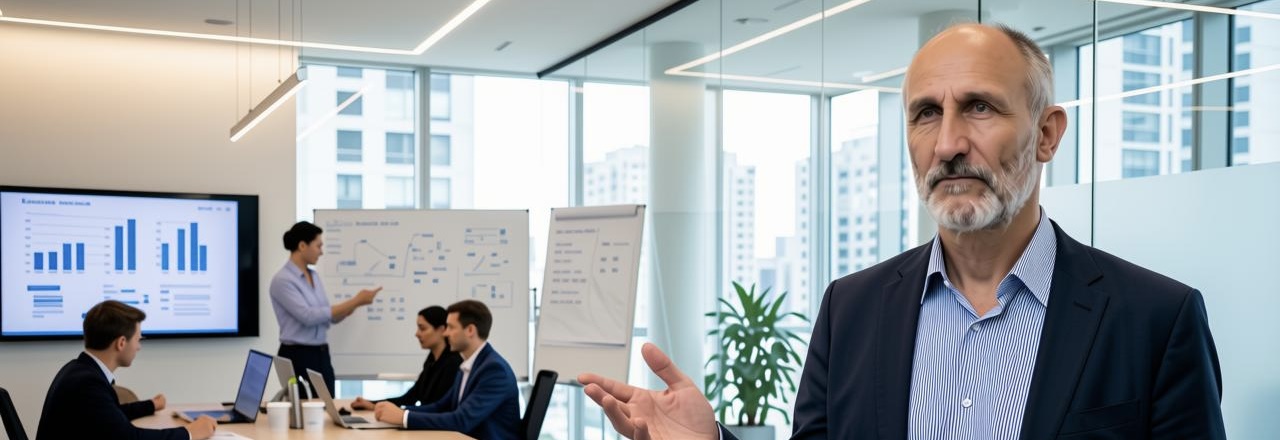
Eric Nemec moderating a transformation workshop — flipcharts and group work in progress

Flagship: Mergers, Carve-Outs & TSA Exits

Nothing proves the two-worlds-in-one-leader claim like a merger — legal entities, contracts, processes, reporting structures, systems and cultures must become one, on a fixed date. These programmes are where I am at my best.

TSA Exit Following a Multi-Billion Acquisition

Managed the separation from a global industrial group: networks, workstations, applications, user accounts — including an automated semiconductor factory with redundant data centres for manufacturing control. A 1,000+ member project team across five cooperating companies, delivered through disciplined cross-company people management.

Merger of Legal Entities with Fixed Legal Deadline

Merged the legal entities of a global energy group — analysing an S/4HANA landscape of 250+ applications, modifying the affected IT and business processes, integrating the changed group reporting structures, and executing the change to a legally defined, non-extendable deadline.

Global Transformation Programmes

Complaint management redesigned end-to-end across 76 countries and ~5,000 people (~$27M budget). HR and process transformation across 40 countries. European banking functions centralised to a Swiss platform. Different industries, one constant: the business and its systems changed as one programme.

Why It Works

In the Room From the Start

I am invited into the strategy discussion, not briefed after the business blueprint is finished. Because I have founded and run businesses myself, leaders speak with me as a peer — and because I started as an engineer, I can take the resulting decisions all the way into the systems without losing anything in translation.

People Change, Not Just Structures

When I manage programmes, I manage people. I understand stakeholders' perspectives, motivations and personal drivers — from the C-level executive to the shop floor — and adjust my communication to each. A transformation succeeds when the people can work tomorrow the way they were promised they could.

Respect for Heritage

Understanding an organisation means understanding its heritage: why it is built the way it is, what shaped its culture, what constraints it carries. I build on existing know-how rather than imposing templates from outside — change that ignores history gets ignored back.

Your Organisation Is About to Become Something New?

First conversation is free — you will know quickly whether I can help, and I will tell you honestly if I am not the right one.

Book a Consultation