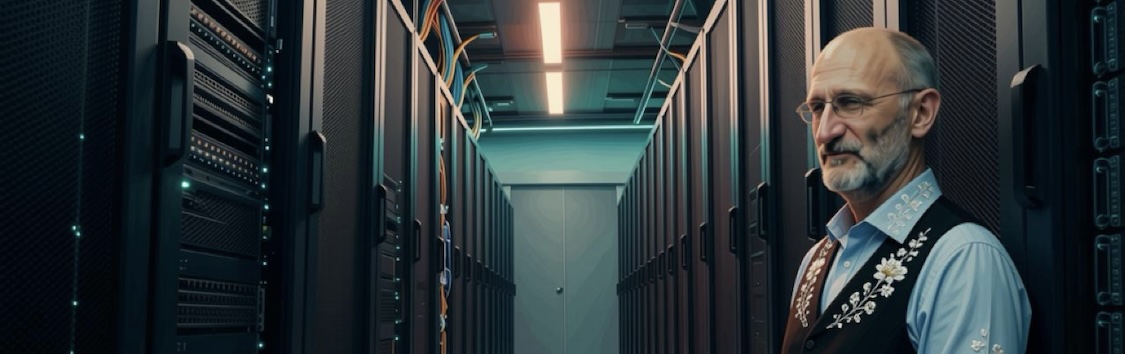
Transformations run in two directions.
Sometimes the business moves first: a new strategy, a merger, a new
regulation — and the technology landscape must be reshaped to follow.
Sometimes technology moves first: S/4HANA, cloud, consolidation —
and the business must reshape how it works around the new systems.
In both cases, I lead the whole programme. One accountable leader, one direction: forward.
"SAP R3 must become S/4HANA, the data centres must consolidate, 250+ applications are entangled with each other — and operations cannot stop for a single day." Or the other way round: "The business has decided — new structure, new markets, post-merger — and now processes, roles and systems must all follow. Together. On time."
Whichever side of that conversation you are on, you are in the right place. There is no such thing as a pure IT transformation — every system change forces processes, structures and people to change with it. And there is no pure business transformation — every new strategy eventually lands in systems. Most programmes fail at exactly that seam. I lead both sides of it in one programme: strategy, processes, organisation, technology, cutover, rollout, hypercare — with a single accountable owner and daily executive reporting.
When I run a programme, I run the whole of it: the business blueprint and the technical architecture, the role descriptions and the system landscape, the works-council alignment and the vendor management. You never have to split your transformation into a "business part" and an "IT part" — or hand one side to someone who only understands it as a memo from the other.
My relationship with AI is hands-on. I direct the development of an AI system that supports radiologists in analysing MRI images — measurements and deviation-from-normal diagnosis support, delivered through a whole set of cooperating AI systems. I design the business processes that carry such systems into customer organisations: clinics, hospitals, specialised labs. And I operate my own AI agent network — AI-controlled scripting machines running recurring programme tasks across multiple AI systems. When your transformation involves AI, you get a programme director who has built, integrated and run the technology in question.
New strategy, merger, reorganisation, market entry — when the business moves, the processes, roles, systems and data must move with it. I design and deliver the complete change, treating the IT landscape as an integral part of the business design rather than a downstream afterthought to be briefed later.
When legal entities merge, carve out or restructure, the group's consolidated reporting — accounting structures, consolidation rules, key figures, deadlines — must change with them, or the first closing after Go-Live fails. I treat reporting requirements as a design driver from day one: which figures must exist, in which structure, for whom, by which date. Not as a requirement discovered during testing.
SAP migrations, data centre transitions, cloud enablement, IT landscape consolidation — delivered with the understanding that a Go-Live only succeeds when 5,000 users can still do their jobs the next morning. Freeze planning, cutover and hypercare are planned around the business, not the other way round.
I don't observe development from a distance — I come from it. Head of R&D for ERP systems, architect of middleware and interfaces, owner of a portfolio of roughly 200 software projects across international subsidiaries; and to this day, development-led programmes count among my regular mandates, most recently in industrial access solutions and large-scale platform environments. Vendors notice: estimates, architecture claims and "technical necessity" get examined by someone who could do the work himself.
Concept, planning and execution of data centre builds, consolidations and migrations — including redundant setups for manufacturing control, and the hard topics others avoid: power, cooling, fire suppression, regulatory compliance, and the specific infrastructure requirements of SAP systems.
Nothing proves the two-worlds-in-one-leader claim like a merger — legal entities, contracts, processes, systems and cultures must become one, on a fixed date. These programmes are where I am at my best.

Managed the separation following a multi-billion acquisition: networks, workstations, applications, user accounts — including an automated semiconductor factory with redundant data centres for manufacturing control. A 1,000+ member project team across five cooperating companies, delivered through disciplined third-party and cross-company people management.
Merged the legal entities of a global energy group — analysing an S/4HANA landscape of 250+ applications, modifying IT and business processes, testing every affected element, and executing the change project to a legally defined, non-extendable deadline.
Transferred treasury and securities tax functions for a major bank from European subsidiaries to the Swiss data centre platform — a workstream of twelve interlinked projects spanning organisation, processes and technology.
I started as an engineer — programming, architecture, embedded systems — then founded and ran businesses myself. Because of that, I am invited into the strategy discussion, not briefed after the business blueprint is finished. Leaders call me before the decisions; engineers trust me because I can challenge their designs. Both sides accept being managed — that combination is rare.
Process owners, works councils, end users, vendors, executives — a transformation succeeds when the people can work tomorrow the way they were promised they could. Training, communication and change management are planned as part of the programme, not bolted on when resistance appears.
Certified and battle-tested across SAFe, Scrum, Kanban, DevOps, PMI, PRINCE II. I balance agile and classical approaches to a pragmatic optimum — the situation decides, not the framework.
First conversation is free — you will know quickly whether I can help, and I will tell you honestly if I am not the right one.
Book a Consultation